Heated bathroom floor cost runs $8 to $16 per square foot installed in Salt Lake City. Worth it in bathrooms for the daily comfort, rarely worth it in other rooms, and only if it's planned before the tile goes down.
Let's start with the number, because it's the thing everyone wants first. The heated bathroom floor cost in Salt Lake City typically runs $8 to $16 per square foot installed for an electric mat system. That figure is for the heating system itself. The tile that goes over the top is a separate line, priced by the material you choose.
That spread is wide for a reason. Three things move the cost up or down:
Subfloor prep is the piece clients underestimate most. Before a single mat rolls out, the floor beneath it has to be flat and solid. If it isn't, we level it. An old home on the east bench might need more work here than a newer build in Draper, and that shows up in the price. The mat itself is a small part of the bill. The labor around it is the rest.
Square footage is the biggest lever, because the mat only heats where you place it. A small primary bath and a sprawling spa suite don't land in the same spot on that range. We scope the exact number during design, once we know the room, the layout, and what's under the floor. That way the heated bathroom floor cost you approve is the one you actually pay.
There's also the thermostat and controls to account for. A basic model runs the floor on a simple timer. A smart thermostat learns your schedule and trims energy use, and it adds a little upfront. It's a small line, but it's part of the honest total, so we put it in front of you early rather than at the end.
One thing worth saying plainly: this is a finish-level upgrade, not a line you trim to save a few dollars. Done right, it disappears into the floor and you never think about it again.
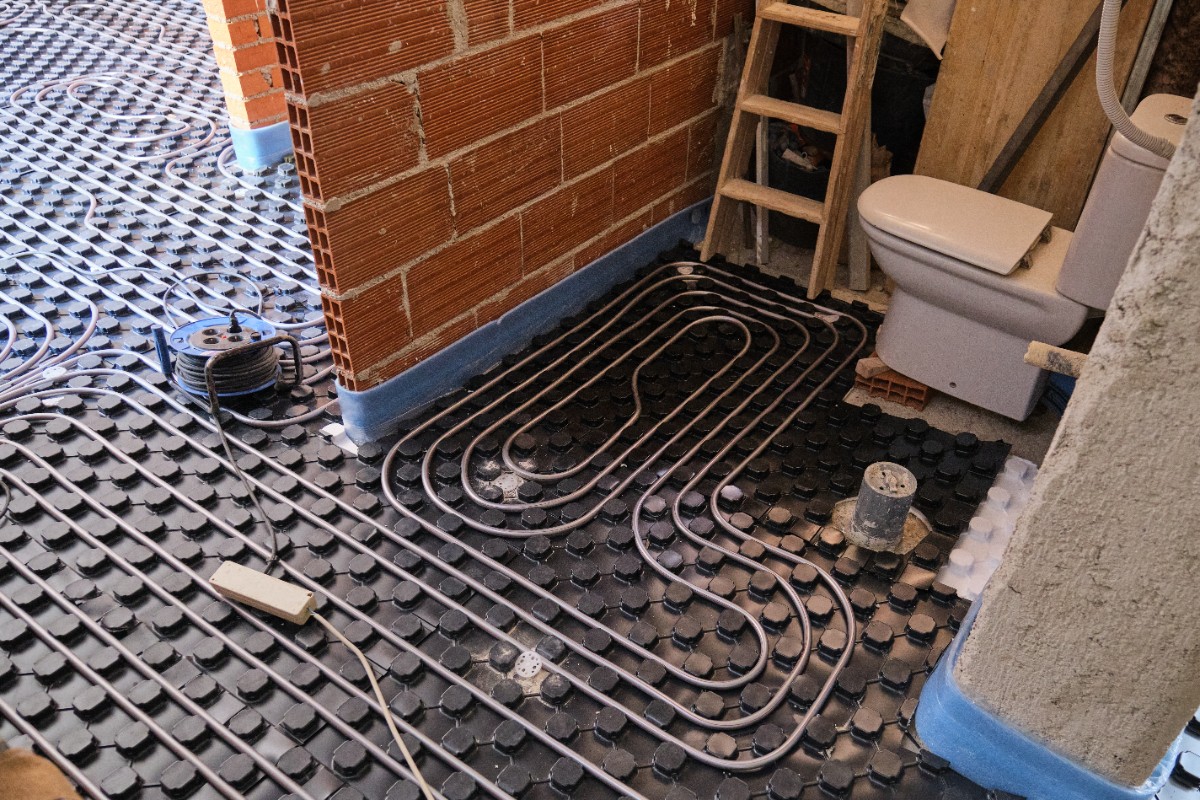
There are two ways to warm a floor, and they aren't close in cost or use case. Any radiant floor heating bathroom project in Utah starts with this choice, and the radiant floor heating cost per square foot depends almost entirely on which one you pick.
A thin mat of heating cable rolls out under your tile and wires to a thermostat. This is the standard for a single bathroom: low upfront cost, fast to install with the tile, and sized precisely to the room. For most clients, electric radiant heat for a bathroom in Utah is the practical choice.
Hydronic runs warm water through tubing under the floor, fed by a boiler or water heater. Higher install cost, more equipment, and cheaper to run only across very large areas. For one bathroom, it's overkill.
For a single luxury bath, electric mat wins almost every time. The run is short, the install is clean, and you aren't plumbing a boiler loop for one room. We spec hydronic only when a client is heating a large connected floor or building new, which keeps the radiant floor heating cost per square foot where it should be.
Most people never think about this part until it's a problem. A heated tiled floor adds height. Not much, but enough to matter.
None of this is hard. It's just a decision you make on paper, before anyone orders tile. When the levels are planned, the floor sits flush, the doors swing clean, and the transition into the hallway looks intentional. When they aren't, you end up shaving a door down after the fact or living with a lip at the threshold. We'd rather solve it in the drawing than on site.
This is the most common thing clients miss. A heated floor sits under the tile. It is not something you slide in afterward.
If the tile is already down and you want heat, the only path is to pull the floor and start over. That's why the in-floor heating bathroom cost is really a tile-job cost. The two aren't separate projects. They're one, and they share the same install window. It's also why your tile choice and your heating layout get decided together, which we handle as part of the same bathroom tile and fixtures selection.
The sequence is fixed, and every step depends on the one before it:
Drop the heat in late and that whole order breaks. That's why it can't be an afterthought.
So the honest rule is simple: decide during design, not after. If a heated floor is even a maybe, we plan for it from the first drawing. That's also why we treat the heating layout as part of the floor build itself. You can see how we approach the full floor assembly on our bathroom flooring service page.
Utah changes the math here. A lot of mountain homes sit on tile laid over an unheated crawl space. Cold air pools under the floor all winter, and that tile stays cold no matter how warm the room air gets.
The physics are straightforward. A valley home on a slab holds some ground warmth under the floor. A canyon home over an open, vented crawl space doesn't. Winter air moves through freely, and the underside of your tile sits at nearly the same temperature.
There's a second reason it matters up high. A cold tile floor pulls heat off your feet fast, so the whole room reads colder than the thermostat says, and you end up pushing the furnace harder to compensate. Warm the floor and the room feels comfortable at a lower air temperature.
If you own a home up the canyon or in Summit County, this is why heated floors are worth more here than in a valley slab home. The floor was never going to warm up on its own. It's one of the details we plan around in any Park City mountain home remodel.

Time for the honest verdict. We install these all the time, and we still tell clients no in certain rooms. Here's the real answer.
In a bathroom, yes. It's the one room where you stand barefoot on tile, often first thing in the morning, and the payoff is immediate and daily. Whether radiant floor heating is worth it comes down to the room. Bathrooms and mudrooms earn it. A bedroom or a hallway rarely does.
The pattern is simple. If it's a room where bare feet meet cold tile, heat pays off. Everywhere else, you're spending on comfort you won't feel. It's a natural fit in a spa-style primary bath, where warmth underfoot matches the rest of the room.
Clients always ask if heated floors are expensive to run. For a bathroom-sized zone, no. The heated floor energy cost is modest because the mat is small and you run it on a schedule, warm for the morning, off during the day. You're heating a few square feet on a timer, not the whole house. A programmable thermostat does most of the work, waking the floor before you do and shutting it off once you've left for the day.
In a premium market like ours, a heated primary bath reads as a luxury signal to buyers. Do heated floors increase home value on their own? Not dollar for dollar. But as part of a high-end bath in Park City or on the east bench, they support the price and help the room show well against everything else on the market.
Because the layout gets locked before tile, we render it first. Every project includes 3D design, and the heating zones go straight into that model.
Mapping it this way isn't a cosmetic step. Heating the wrong square footage costs money to install and money to run, so we place the mat only where your feet go. The model shows you the plan, you approve it, and the floor we build matches the drawing exactly. That's the whole point of planning it as one job.
At around $8 to $16 per square foot, a heated bathroom floor is one of the few upgrades you feel every single morning. In a bathroom, it earns that money. In most other rooms, it doesn't. And it only works if you plan it before the tile goes down, because there's no clean way to add it after.
At Renovation Brothers, we build the heating into the floor from the first drawing, so your tile and your warmth are planned together instead of patched together later. If you're weighing a heated floor for a Salt Lake City or Park City bath, contact us for a quote and we'll map the zones to your room before anything gets ordered.
Roughly $8 to $16 per square foot installed for an electric mat system. The exact figure depends on room size and subfloor condition, with a smaller bath at the lower end. We confirm it during design, once we've measured the room.
No, not for a single bathroom. The mat is small and runs on a schedule, so you're warming only a few square feet during the hours you use the room. Most clients set a morning timer and barely notice it on the bill.
No. The system installs beneath the tile, so adding it means removing the existing floor first. If a heated floor is a possibility, decide during design, before the tile is ordered and set.
Electric mat, in nearly every case. It's lower cost, quicker to install with the tile, and sized to the room. Hydronic only makes sense for large connected floors or new construction, not a single bath.
Not dollar for dollar on their own. But in a luxury bath in a premium market like Park City or the east bench, a heated floor supports the asking price and helps the room show as high-end.
A fraction of an inch, from the mat and thinset combined. It's minor, but it affects door clearance and thresholds, which is why we account for it in the design before installation.
Decades, when a quality electric system is installed correctly under tile. The tile above usually sets the real timeline, and proper installation is what protects that lifespan.

Begin your transformation with a free estimate from Renovation Brothers today!

Skilled home remodelers in Utah, creating personalized, high-quality renovations for every home.
License No.: 10884505-5501
Ready to start?
Request a quote


